
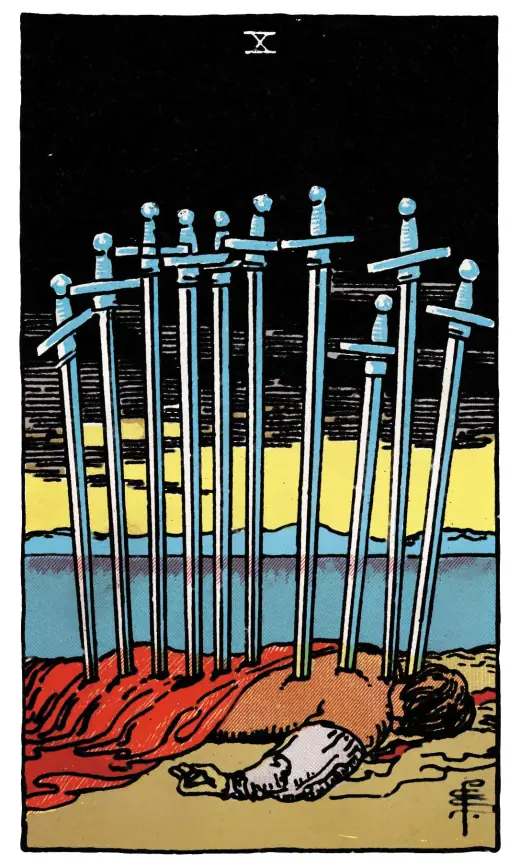
Ten of Swords — tarot card meaning
The Ten of Swords marks a painful ending, betrayal, or rock bottom — and the promise that the worst is over and a new dawn is already rising.
Upright
Reversed
Upright meaning
The Ten of Swords is the final card of the suit of Swords, the suit of air, intellect, and hard truth — and it depicts the most dramatic ending in the Minor Arcana. Upright, it signals a painful but definitive conclusion: a betrayal, a collapse, a situation that has run its full course and cannot be revived. Something has ended, completely and unmistakably.
Yet the card carries an unexpected mercy. Ten is the number of completion, and when a cycle finishes at rock bottom, the only remaining direction is up. The dawn breaking on the horizon of the card is not decoration — it is the message. The crisis you feared has already happened; the anticipation is over, and with it goes the exhausting mental struggle the Swords describe.
In a reading, the Ten of Swords asks you to stop resuscitating what is finished. Acknowledge the loss honestly, let yourself grieve, and notice that the pain of this ending is also the release from it. What falls away now clears the ground for a genuinely new chapter, one no longer built on a failing foundation.
Reversed meaning
Reversed, the Ten of Swords points to recovery in progress — you are getting up after the worst has passed, and strength returns gradually. Old wounds are closing, and the crisis is losing its grip on your thoughts. Alternatively, the reversal can show resistance to a necessary ending: clinging to a situation that has already collapsed, replaying a betrayal, or dramatizing pain to avoid moving on. Ask yourself which reading fits. If you are healing, be patient with the pace. If you are holding on, the card urges you to release the past so regeneration can truly begin.
In love & relationships
In love, the Ten of Swords often marks the definitive end of a relationship or a deep wound such as betrayal or broken trust. If a breakup has happened, the card confirms it is final — reviving it would only prolong the pain. For couples, it can expose a hurtful truth that must be faced before anything can change. The compassionate message is that heartbreak, once fully acknowledged, stops recurring: the dawn behind the swords promises that your capacity to love survives this ending intact.
In career & money
In career and money matters, the Ten of Swords can indicate a job loss, a failed project, a collapsed deal, or workplace betrayal — being undermined or passed over despite your efforts. The situation is beyond salvaging, and continuing to fight for it drains you. Cut your losses cleanly, document what went wrong, and protect your finances while you regroup. This ending frees you for work that fits better; many people look back on this card's moment as the push toward a stronger position.
Symbolism
Pamela Colman Smith's illustration shows a man lying face down on dark ground, ten swords planted along his back — a deliberately excessive image, since one blade would suffice. The exaggeration tells us the mind has made the defeat total; the worst imaginable has already occurred. A red cloak drapes his lower body, and his right hand forms a subtle gesture of blessing. The sky above is heavy and black, but along the horizon a golden dawn breaks over calm water and distant mountains. The still sea suggests emotional peace after turmoil, and the rising light is the card's core promise: night ends here.
Self-reflection prompt
The Ten of Swords invites a searching question: what am I still keeping alive that has, in truth, already ended? Journal about the situation you replay most often — the betrayal, the failure, the loss — and write down what it would mean to declare it finished. Notice whether your suffering comes from the event itself or from the story you keep retelling about it. Then ask: if the worst has already happened, what am I now free to begin?