
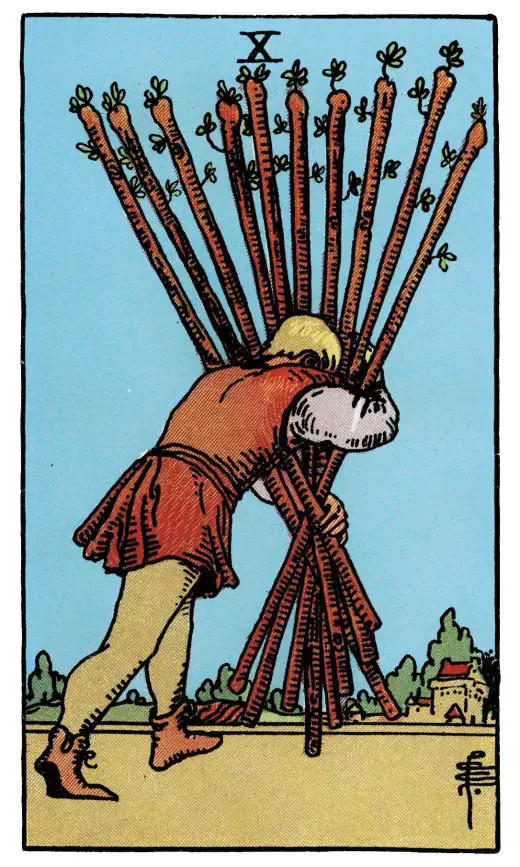
Ten of Wands — tarot card meaning
The Ten of Wands shows a man carrying ten heavy staves toward town: burden, overwork, and responsibility carried alone, close to the finish line.
Upright
Reversed
Upright meaning
The Ten of Wands is the card of burden and overcommitment. As the tenth and final numbered card of the suit of Wands, ruled by the element of fire, it shows what happens when the suit's creative energy is taken to its limit: the projects have succeeded, and now everything must be carried at once. The card speaks of hard-won responsibility that has become heavy — duties, obligations, and workloads accepted willingly but now pressing down on your shoulders.
Upright, the Ten of Wands acknowledges real effort. You are working hard, likely harder than anyone around you realizes, and the goal is genuinely within reach. The figure in the image is close to town; the struggle is nearly over. But the card also warns that you have taken on too much alone. Some of those ten staves belong to other people, or belong to no one at all.
Practically, this card asks you to audit your load. Which commitments are truly yours? What can be delegated, postponed, or dropped entirely? Success that costs your health and joy is not the success the Wands promised. Finish the essential task — then set the rest down.
Reversed meaning
Reversed, the Ten of Wands often marks the moment the load finally shifts. At its best, it shows delegation, asking for help, and the relief of putting down burdens that were never yours to carry. Responsibilities are being released, a heavy chapter is closing, and energy returns. At its more difficult edge, the reversal warns of collapse under pressure: burnout, dropped commitments, or avoiding duties instead of resolving them. It can also expose martyrdom — carrying weight to feel needed. The remedy is honest triage: keep what matters, hand off what you can, and let the rest fall.
In love & relationships
In love, the Ten of Wands points to a relationship weighed down by duties rather than lifted by affection. One partner may be carrying most of the emotional or practical load — household, finances, planning — and quietly exhausting themselves. Romance has been buried under responsibility. The card advises redistributing the weight: name what you carry, ask directly for help, and make room for lightness again. For single querents, it can show being too consumed by work or obligations to open space for a relationship.
In career & money
In career readings, the Ten of Wands is the classic overwork card: too many projects, extra duties absorbed without extra support, the person everyone relies on. Your effort is real and the finish line is near, but the current pace is unsustainable. Delegate, renegotiate deadlines, or decline the next request. Financially, the card can show heavy obligations — debts, mortgages, supporting others — that demand disciplined management. Push through the final stretch of the essential task, then restructure your workload before taking on anything new.
Symbolism
In Pamela Colman Smith's Rider–Waite–Smith illustration, a man bent forward carries a bundle of ten flowering staves clutched awkwardly against his chest, so that they block his own view of the road ahead. He trudges across plowed ground toward a town with houses and trees in the near distance — the destination is visible and close. The clear sky shows the problem is not the world but the load. His stooped posture embodies self-imposed burden; the sprouting wands show the responsibilities are alive and worthwhile, yet gathered all at once they obscure his vision. The nearby town promises that relief comes with completion.
Self-reflection prompt
The Ten of Wands invites a searching question: which of these burdens did I actually choose, and which did I simply fail to refuse? Journal about the weight you carry — list every current obligation, then mark whose it truly is. Notice whether being overloaded has become part of your identity: do you equate exhaustion with worth, or busyness with love? Ask yourself what you are afraid would happen if you set something down, and whether that fear belongs to the present or the past.