
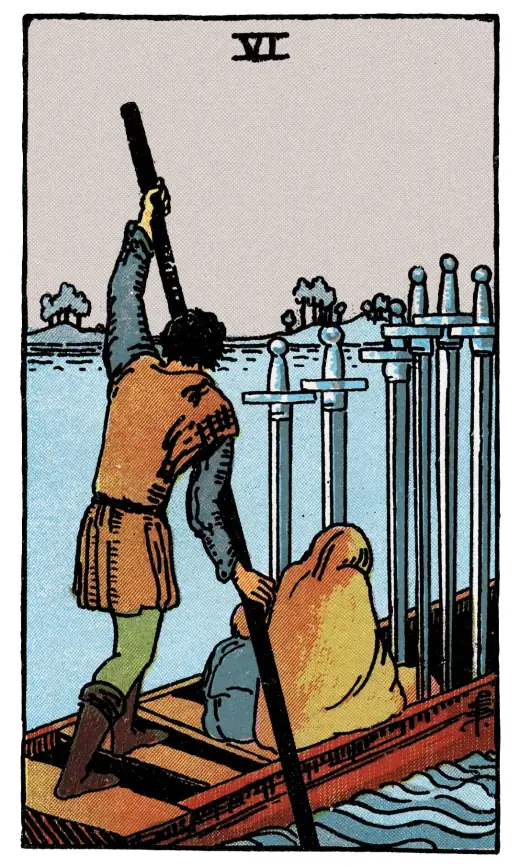
Six of Swords — tarot card meaning
The Six of Swords marks a necessary transition: leaving turbulent waters behind and moving toward calmer shores, recovery, and mental clarity.
Upright
Reversed
Upright meaning
The Six of Swords is the card of passage. It appears when you are leaving a difficult situation behind — not with fanfare, but with the quiet resolve of someone who knows the crossing must be made. In the suit of swords, ruled by the element of air, this six represents the mind choosing a wiser course: stepping away from conflict, grief, or exhausting circumstances toward something more stable.
Upright, the card promises that the worst is behind you. The waters you are moving through may still feel unsettled, but the destination ahead is calmer. This can be literal travel or relocation, but more often it is an inner journey: a shift in perspective, the end of a painful chapter, a gradual recovery. Progress here is steady rather than dramatic.
The Six of Swords also carries a note of help received. In the Rider-Waite-Smith image, a ferryman guides the boat — you do not have to make this crossing alone. Accept support, trust the process, and keep moving forward. What you leave behind was heavy; what awaits is lighter, even if it does not feel that way yet.
Reversed meaning
Reversed, the Six of Swords warns that a needed transition is stalled. You may be clinging to a situation, relationship, or mindset you have already outgrown, or attempting to move on while dragging unresolved baggage with you. Sometimes it points to a return to old troubles — going back to the very waters you tried to leave. The card asks you to name what truly holds you in place: fear of the unknown, unfinished conversations, or guilt. Until that anchor is lifted, the boat cannot cross. Resolve what remains, then depart properly, without looking back.
In love & relationships
In love, the Six of Swords signals moving past a rough patch. Couples who have weathered conflict find calmer waters ahead — provided both partners genuinely leave old grievances behind rather than carrying them into the next chapter. For those healing from a breakup, the card confirms you are in recovery: the pain is receding, even if slowly. It can also indicate a relationship changed by distance or relocation. Trust the direction of travel; the emotional climate is improving.
In career & money
In career and money matters, the Six of Swords points to a transition: changing jobs, relocating for work, moving to a new team, or shifting your professional direction after a stressful period. The move may feel like a step sideways, but it leads to steadier ground. Financially, it suggests recovery from a difficult stretch — gradual improvement rather than a sudden windfall. Accept guidance from mentors or advisors; someone with experience can help you navigate the crossing.
Symbolism
In Pamela Colman Smith's illustration, a ferryman poles a small boat across a body of water. A cloaked woman sits hunched with a child beside her, their backs to the viewer — they carry sorrow but face forward. Six swords stand upright in the bow: the burdens and hard lessons they take with them, yet held in order rather than wielded. The water on the right side of the boat is rippled and troubled, while the water ahead, on the left, lies smooth — the visual heart of the card's promise. A far shore with low land signals that the destination is real and reachable.
Self-reflection prompt
The Six of Swords invites a quiet inventory. Ask yourself: what am I ready to leave behind, and what am I still carrying that no longer serves the journey? Notice the difference between memories that teach and memories that anchor. Journal about a crossing you have already survived — what got you through it, who helped, and what you learned about your own resilience. Then name the calmer shore you are moving toward, in concrete terms, so the passage has a destination.