
Five of Swords — tarot card meaning
The Five of Swords signals conflict won at too high a cost: hollow victory, discord, and the question of whether being right was worth the damage.
Upright
Reversed
Upright meaning
The Five of Swords is the card of the hollow victory. As the fifth card in the suit of Swords — the suit of air, intellect, and communication — it shows what happens when the mind's sharpness is turned into a weapon. A battle has been won, but the cost was too high: relationships damaged, trust broken, goodwill spent. The card asks a pointed question: even if you can win, should you?
Upright, this card often describes conflict driven by ego and self-interest. Someone in the situation — possibly you — has prioritized being right over being kind, or winning over preserving the relationship. There may be arguments, gossip, intimidation, or a competitive dynamic where every gain for one side feels like a loss for the other. Alternatively, you may be on the losing end, walking away from a fight that was never fair.
The deeper counsel of the Five of Swords is to choose your battles. Some conflicts are not worth entering, and some victories are indistinguishable from defeats. Consider whether pride is steering your decisions, and whether a strategic retreat, an apology, or simply letting go would serve you better than one more round of combat.
Reversed meaning
Reversed, the Five of Swords points toward the end of a conflict — or the urgent need to end one. Old resentments are ready to be released; an apology may finally be offered or accepted. This position often marks the moment you realize a fight has dragged on far past its usefulness and decide to make amends or simply walk away with your dignity intact. Its shadow side is the grudge that will not die: replaying old arguments, refusing to forgive, or fearing conflict so much that you never stand up for yourself. Choose genuine closure over silent bitterness.
In love & relationships
In love, the Five of Swords warns of arguments where winning has become more important than the relationship itself. Sharp words, score-keeping, and the need to have the last word are eroding intimacy. One partner may feel defeated or humiliated rather than heard. If you are single, it can point to lingering bitterness from a past breakup that colors new connections. The remedy is the same in every case: drop the sword first, and trade being right for being close.
In career & money
At work, the Five of Swords describes a cutthroat atmosphere: office politics, credit-stealing, gossip, or a colleague who wins by making others lose. You may have prevailed in a workplace dispute only to find the atmosphere poisoned afterward. Financially, it cautions against deals where your gain requires someone else's harm, and against unethical shortcuts that will cost your reputation. Pick battles that genuinely matter, document your work, and refuse to be drawn into conflicts staged for someone else's benefit.
Symbolism
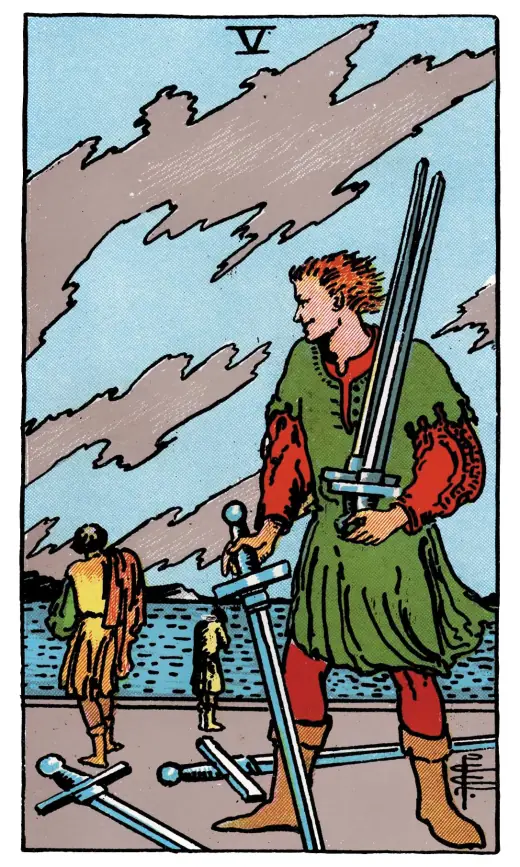
In Pamela Colman Smith's illustration, a smirking man in the foreground gathers three swords into his arms while two more lie at his feet — he holds all five, the spoils of the fight. Two defeated figures walk away toward the water, one with his head buried in his hands. Above them, jagged, wind-torn clouds streak a turbulent sky, mirroring the churned emotions the battle leaves behind. The victor's sly backward glance is the card's key detail: he has won everything and yet stands alone. The abandoned swords and retreating figures show that in some conflicts, every participant loses something.
Self-reflection prompt
The Five of Swords invites an honest audit of your conflicts. Ask yourself: where in my life am I fighting to win rather than to understand? Journal about a recent argument — what did victory actually get you, and what did it cost? Notice whether you identify with the smirking victor or the retreating figures, and what that says about the role you habitually take. Then ask the card's hardest question: which battle in my life is ready to be laid down?