
Five of Wands — tarot card meaning
The Five of Wands stands for conflict, competition and clashing egos — energetic friction that can spark growth when channeled well.
Upright
Reversed
Upright meaning
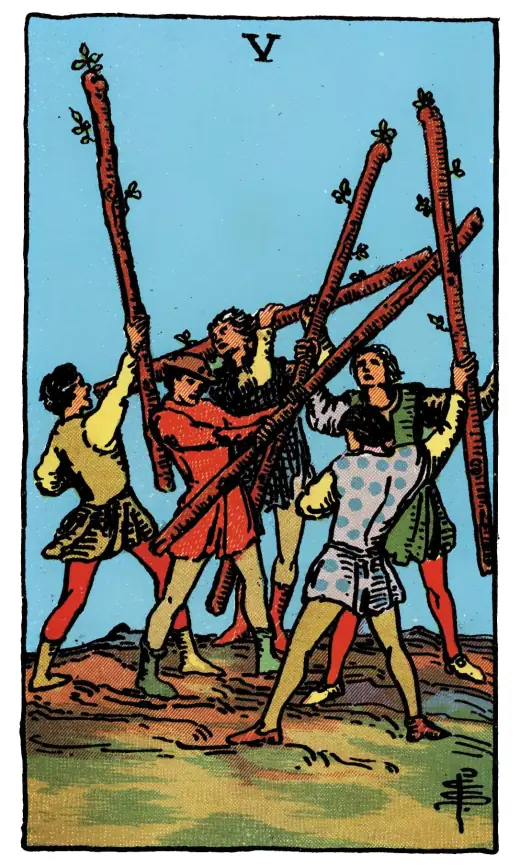
The Five of Wands is the card of friction in the suit of fire. Five people wave their staves at once, and no two of them push in the same direction. Upright, it points to competition, disagreement, and scattered energy: a meeting where everyone talks over everyone else, a project pulled apart by rival visions, a group where strong wills collide. The conflict here is rarely destructive — it is noisy, low-stakes sparring rather than open war.
Because Wands carry the element of fire — will, passion, and creative drive — this five shows what happens when that fire has no shared focus. Tension rises, tempers flare, and progress stalls, yet the same heat can temper ideas the way a forge tempers steel. Honest debate, fair rivalry, and a bit of competitive pressure often produce better results than polite silence.
As the fifth card of the suit, it marks the classic midpoint crisis of the Minor Arcana fives: the stability of the Four of Wands has been disrupted, and the challenge now is to turn chaos into constructive struggle. Pick your battles, state your position clearly, and look for the common goal hiding under the noise.
Reversed meaning
Reversed, the Five of Wands shows conflict that has either gone underground or begun to dissolve. You may be avoiding a necessary confrontation, swallowing frustration until it turns into inner tension, passive aggression, or burnout. Alternatively, the reversal can mark the welcome end of a dispute: rivals find compromise, a competitive phase closes, and scattered energy finally aligns. Ask whether peace has truly been made or merely performed. If the argument was never voiced, it will resurface; if it was resolved, this card gives you permission to lay down your stick and move on.
In love & relationships
In love, the Five of Wands points to bickering, clashing temperaments, or rivalry. A couple may be arguing over small things while the real issue — attention, priorities, respect — goes unnamed. For singles, it can mean competing for someone's interest or dating in a crowded, flirtatious field. The passion behind the friction is genuine: this is heat, not coldness. Channel it into honest conversation and playful challenge rather than point-scoring, and the spark that fuels the quarrels can fuel the attraction instead.
In career & money
At work, the Five of Wands describes a competitive arena: rival candidates for one role, teams fighting over resources, brainstorms where every voice pulls a different way. Office politics and clashing egos may be slowing a project down. Financially, it warns against scattered efforts — too many small ventures competing for the same budget and energy. The upside is real: fair competition sharpens your skills and your pitch. State your ideas confidently, back them with results, and treat rivals as sparring partners who make you better.
Symbolism
Pamela Colman Smith's illustration shows five young men on open ground under a plain blue sky, each brandishing a large wooden stave. They appear locked in battle, yet no one lands a blow — the raised wands almost form a lattice, suggesting mock combat, a game, or a scuffle of egos rather than true violence. Their multicolored tunics mark five distinct wills, none dominant. The bare, uneven terrain offers no prize worth the fight, hinting that the struggle itself is the point. The sprouting leaves on each stave show that even this chaotic clash carries living, creative energy.
Self-reflection prompt
The Five of Wands asks you to look at how you fight. When conflict flares, do you meet it openly, avoid it, or secretly enjoy it? Try journaling on these questions: What am I actually competing for right now — and with whom? Which of my current arguments are about the stated issue, and which are about being heard? Where could a rival become an ally if we named a shared goal? Notice whether friction energizes you or drains you; that answer shows where your fire wants direction.