
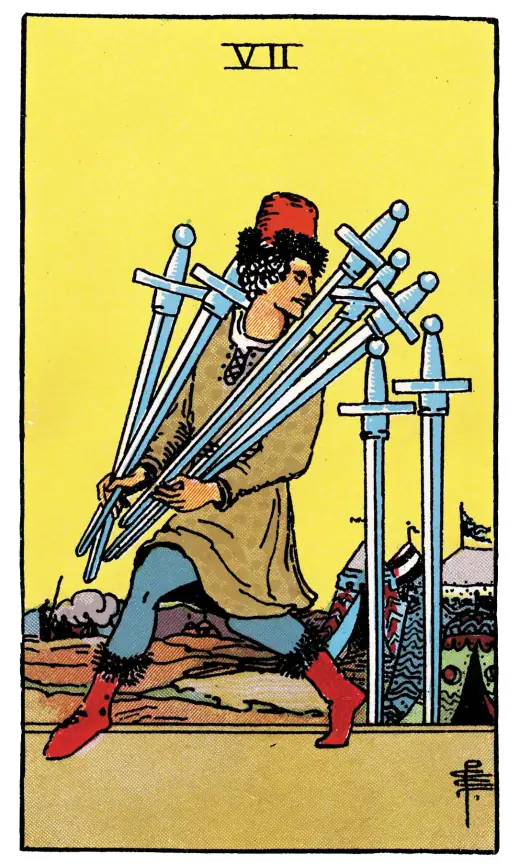
Seven of Swords — tarot card meaning
The Seven of Swords signals deception, stealth and strategy — someone acting alone, cutting corners, or trying to get away with something.
Upright
Reversed
Upright meaning
The Seven of Swords is the card of stealth, strategy and deception in the suit of Swords, the suit of air, intellect and truth. Upright, it points to someone acting alone and in secret: taking what isn't theirs, avoiding a direct confrontation, or trying to get away with something. The trick may be working — for now — but the card's tension comes from what has been left behind and who might notice.
This card is not always about outright theft. Often it describes cunning as a survival tactic: solving a problem sideways rather than head-on, keeping plans quiet, choosing tact over full disclosure. In a reading it asks you to look honestly at where the deception sits. Are you the one slipping away with the swords, is someone deceiving you, or are you deceiving yourself about what a situation really is?
As a seven, it marks a test within the suit's journey — here, a test of integrity. The Seven of Swords warns that shortcuts and half-truths carry a cost, even when no one seems to be watching. The clever route and the honest route are not always the same road.
Reversed meaning
Reversed, the Seven of Swords often marks the moment a deception ends. Secrets surface, a lie is exposed, or conscience wins and someone decides to come clean. It can show you returning what was taken — literally or symbolically — and choosing the direct conversation you once avoided. It may also point inward: self-deception unravelling, or imposter syndrome, the nagging sense that you're getting away with something when in fact you've earned your place. The reversal invites honesty, confession and repair. Owning the truth now is far less costly than being caught holding it later.
In love & relationships
In love, the Seven of Swords urges a clear-eyed look at honesty between partners. It can point to secrets, evasiveness or, at its sharpest, infidelity — someone keeping part of themselves or their actions hidden. More gently, it may show avoidance: dodging a hard conversation instead of facing it. If you're single, it warns against a charming person whose words and actions don't match. The remedy is always the same: direct questions, honest answers, and attention to behaviour rather than promises.
In career & money
At work, the Seven of Swords warns of office politics, credit-taking and information that isn't being shared openly. A colleague may be advancing at your expense, or confidential plans may be leaking. Guard your ideas, document your work, and read the room before trusting freely. Financially, it cautions against schemes that sound too clever — cut corners, hidden fees, deals that rely on someone not reading the fine print. Strategy is welcome; dishonesty will eventually be discovered.
Symbolism
In Pamela Colman Smith's illustration, a man tiptoes away from a colourful military camp carrying five swords awkwardly bundled in his arms, glancing back over his shoulder with a sly smile. Two swords remain planted upright in the ground behind him — his theft is incomplete, and what he leaves behind may betray him. The bright yellow sky suggests the act happens in plain daylight, not under cover of night: boldness, not caution. The distant tents and a small group of figures on the horizon hint that discovery is only a turned head away. His soft red boots and light steps embody stealth itself.
Self-reflection prompt
The Seven of Swords invites an uncomfortable but freeing question: where am I not being fully honest — with others, or with myself? Journal on what you're avoiding saying directly, which shortcuts you justify, and what you fear would happen if you acted in the open. Notice, too, where you assume you must handle everything alone and in secret. What would change if you asked for help instead of slipping away with the problem clutched in your arms?