Two of Swords — tarot card meaning
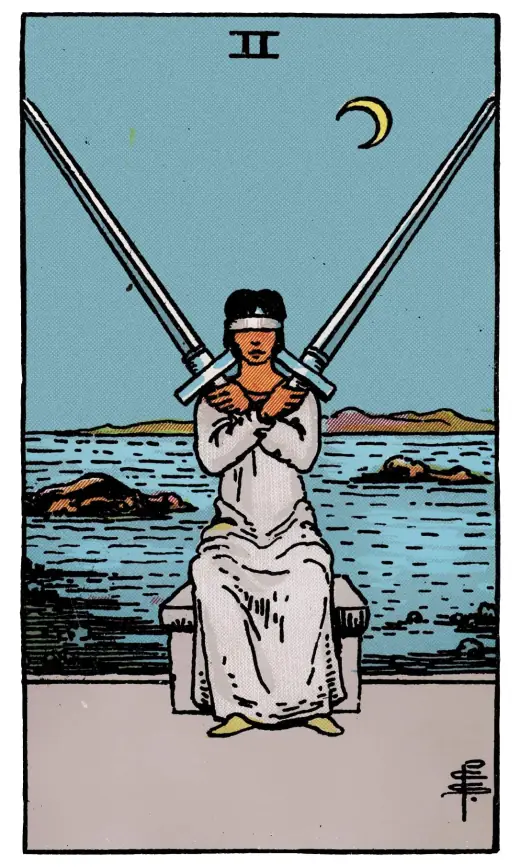
The Two of Swords shows a blindfolded woman holding two crossed swords: a stalemate, a hard choice postponed, and truth kept at arm's length.
Upright
Reversed
Upright meaning
The Two of Swords is the card of stalemate. Two equal forces press against each other, and rather than choose, you have crossed your arms and closed your eyes. In the suit of swords — the suit of air, intellect, and truth — the number two marks the first tension: two ideas, two options, two loyalties that cannot both be honored. The card does not say the choice is impossible; it says you are refusing to look at it.
Often this card appears when you already have enough information to decide but keep waiting for certainty that will never arrive. The blindfold is self-imposed. Avoidance feels like peace, yet the swords are heavy, and holding them in balance costs energy every day.
As guidance, the Two of Swords asks you to remove the blindfold deliberately: name the two options, admit what each would cost, and consult your feelings as well as your logic — the sea behind the seated figure represents the emotions she has turned her back on. A truce is not a resolution. The sooner you look, the sooner your hands are free.
Reversed meaning
Reversed, the Two of Swords marks the moment the blindfold slips. Hidden information comes to light, a delayed decision can no longer be postponed, or the tension you have been holding finally breaks. This can feel like relief — clarity after weeks of fence-sitting — or like overwhelm, when too much truth arrives at once and you feel pulled in both directions. The reversed card can also warn against choosing in panic just to end the discomfort. Slow down, verify what you have learned, and decide from evidence rather than exhaustion. Movement is coming either way.
In love & relationships
In love, the Two of Swords points to an unspoken standoff. A couple avoids a hard conversation — about commitment, money, family, or an old hurt — and calls the silence peace. For singles, it can show hesitation between two people or fear of opening up after past pain. The card's message is direct: emotional withdrawal is not neutrality. Turn back toward the water — toward feeling — and say the thing you have been rehearsing in your head.
In career & money
At work, the Two of Swords describes a decision you keep deferring: two job offers, two strategies, a conflict between colleagues where you are stuck in the middle. Staying neutral may feel professional, but prolonged fence-sitting erodes trust and momentum. Financially, it warns against freezing — neither investing nor cutting losses — while conditions change around you. Gather the missing facts, set yourself a deadline, and commit. An imperfect decision made consciously beats a perfect one made never.
Symbolism
Pamela Colman Smith's illustration shows a blindfolded woman in a pale robe seated on a stone bench before a calm sea dotted with rocky islets. Her arms are crossed over her chest, each hand gripping a long sword, so the blades form a closed X above her shoulders. A waxing crescent moon hangs in the sky at the upper right. The blindfold is chosen refusal to see; the crossed swords are two balanced arguments blocking the heart; the sea at her back is the emotion she excludes from the decision; the rocks are obstacles beneath a deceptively smooth surface; the crescent moon hints at intuition waiting to be used.
Self-reflection prompt
The Two of Swords invites a journaling question: what decision am I pretending I have not already made? Write down the two options as honestly as you can, then note what each would cost you and what staying frozen costs you every week. Ask where the blindfold came from — fear of being wrong, fear of hurting someone, fear of change? Often the body knows the answer before the mind admits it. Notice which option makes your shoulders drop with relief.