
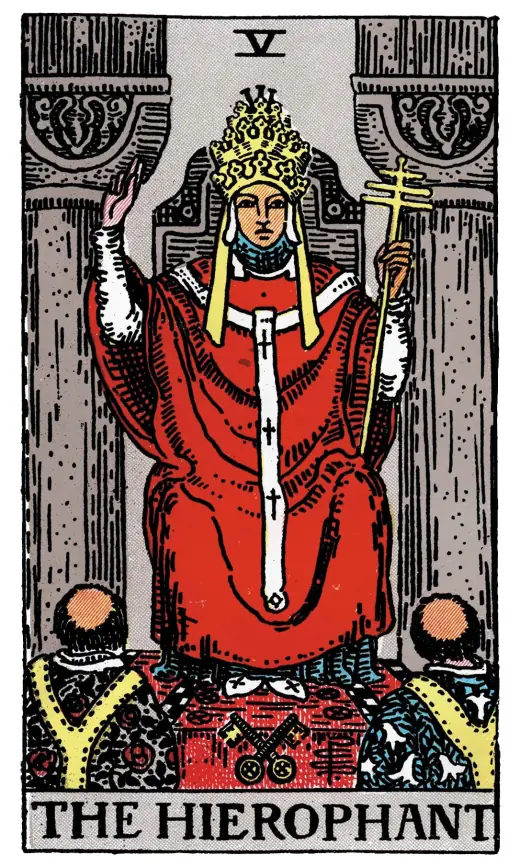
The Hierophant — tarot card meaning
The Hierophant, Major Arcana card 5, represents tradition, spiritual guidance, mentorship, and the wisdom passed down through established institutions.
Upright
Reversed
Upright meaning
The Hierophant is card number 5 of the Major Arcana and the counterpart to the High Priestess: where she guards hidden, intuitive knowledge, he transmits sacred wisdom openly, through teaching, ritual, and institution. Upright, this card points to tradition, established structures, and the value of learning from those who came before you — a teacher, mentor, religious community, school, or any system with a proven lineage of knowledge.
When the Hierophant appears, it often signals a time to work within the rules rather than against them. Conventional paths — formal education, marriage, certification, membership in a group — carry real benefits now. The card also represents a spiritual advisor or counselor entering your life, or your own readiness to seek guidance from a trusted source rather than improvising alone.
On a deeper level, the Hierophant asks you to connect your personal beliefs to something larger: a shared value system, a community of practice, a moral framework. He reminds you that ritual and structure are not cages but containers — vessels that hold meaning steady while you grow. Honoring tradition, in this card's view, is a form of humility and strength.
Reversed meaning
Reversed, the Hierophant challenges dogma and rigid convention. You may feel constrained by rules, institutions, or expectations that no longer fit who you are — a religion you've outgrown, a workplace hierarchy that stifles you, family traditions that feel hollow. This position encourages questioning authority and finding your own path, but it can also warn of rebellion for its own sake, or of a teacher or advisor who misuses their position. The healthiest reading: keep what is genuinely valuable in tradition, release what is merely habit, and trust yourself as your own inner teacher.
In love & relationships
In love, the Hierophant is one of the strongest cards for commitment and traditional milestones: engagement, marriage, meeting the family, building a relationship on shared values. For couples, it favors stability, loyalty, and doing things 'the proper way.' If you are single, it suggests a partner who takes commitment seriously, possibly someone you meet through community, study, or shared beliefs. The card asks whether your values genuinely align with your partner's — because for the Hierophant, lasting love is built on common ground, not just chemistry.
In career & money
In career readings, the Hierophant favors established institutions and conventional paths: large organizations, education, law, medicine, religious or nonprofit work, and any field with clear hierarchies and credentials. It is an excellent card for formal training, certification, or finding a mentor — and equally for becoming a mentor yourself. Financially, it counsels the traditional route: proven investments, reputable advisors, and playing by the rules rather than gambling on shortcuts. Success now comes from mastering the system, not disrupting it.
Symbolism
In the Rider-Waite-Smith illustration, the Hierophant sits enthroned between two grey pillars, wearing a triple crown and red robes, raising his right hand in a blessing with two fingers pointing up and two down — bridging heaven and earth. In his left hand he holds a triple-barred cross, echoing his three-tiered crown and the three levels of his authority. Two tonsured monks kneel before him, receiving instruction, and two crossed keys lie at his feet, symbolizing the keys to sacred knowledge that unlock the conscious and subconscious. The whole scene depicts wisdom transmitted through formal teaching and sanctified tradition.
Self-reflection prompt
The Hierophant invites you to examine your relationship with tradition and authority. Ask yourself: which beliefs did I inherit, and which did I consciously choose? Where do the structures in my life — family customs, institutions, communities — genuinely support me, and where do I follow them out of habit or fear? Consider who your real teachers have been and what they passed on to you. Journaling on this card often reveals the difference between values you truly hold and rules you simply obey — and where you are ready to become a teacher yourself.